The foundation your home sits on affects everything, from energy bills to how much usable space you have, to what happens when the ground shifts or floods roll in.
So which house foundation type actually makes sense for your property? That depends on your soil conditions, climate, budget, and what you want from your home long-term.
This article walks you through all seven foundation types, what they’re good for, and where they fall short, so you can go into that builder conversation knowing exactly what questions to ask.
Quick Comparison of House Foundation Types
| Foundation Type | Pros | Cons | Best For |
| Concrete Slab | Low cost, fast build, pest-resistant | No storage, expensive plumbing repairs, poor in cold climates | Warm climates, flat lots |
| Basement | Maximum square footage, high resale value | High cost, moisture risk, requires drainage systems | Cold climates, extra living space |
| Crawl Space | Easy utility access, works on uneven ground | Moisture and mold risk, requires encapsulation | Sloped lots, repair access |
| Pier and Beam | Elevated protection, minimal excavation | Wood rot risk, requires regular inspection | Flood zones, poor soil |
| Stone | Long-lasting, no manufactured materials | Porous, rarely meets modern building codes | Historic home restoration |
| ICF | Outstanding insulation, soundproofing | Higher upfront cost | Extreme climates, energy efficiency |
| Wood | Fast installation, decent insulation | Moisture-dependent, less durable long-term | Remote areas, fast builds |
1. Concrete Slab Foundation
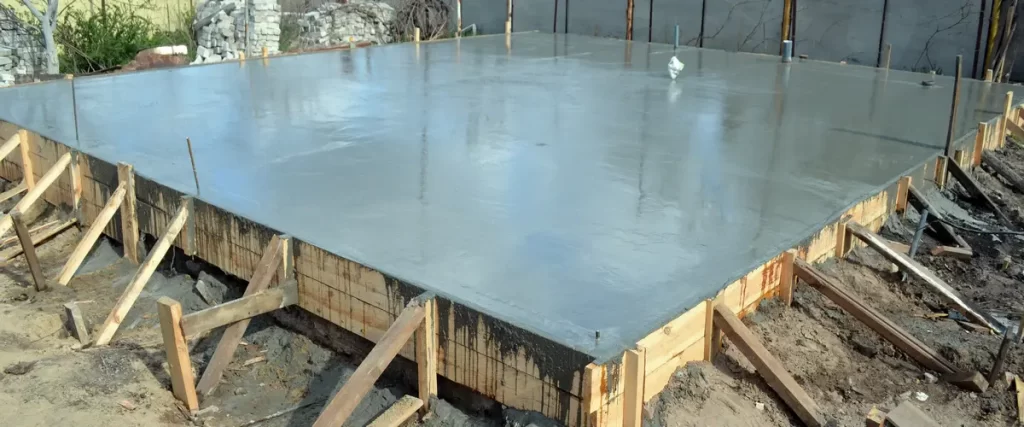
The concrete slab is one of the most common foundation types in warm climates, and for good reason. It’s cost-effective, straightforward to build, and doesn’t require extensive excavation.
A slab-on-grade foundation is essentially a thick, flat concrete pour directly on prepared ground. No basement, no crawl space, just a solid concrete floor between your home and the earth.
Pros:
- Lower construction cost
- Faster build time
- Minimal pest entry points
Cons:
- No storage space or additional living space underneath
- Plumbing runs through the slab, making repairs expensive
- Poor performance in colder climates where the ground freezes
If you’re building in a warm, dry region with stable soil, this is often the most practical option.
2. Basement Foundation
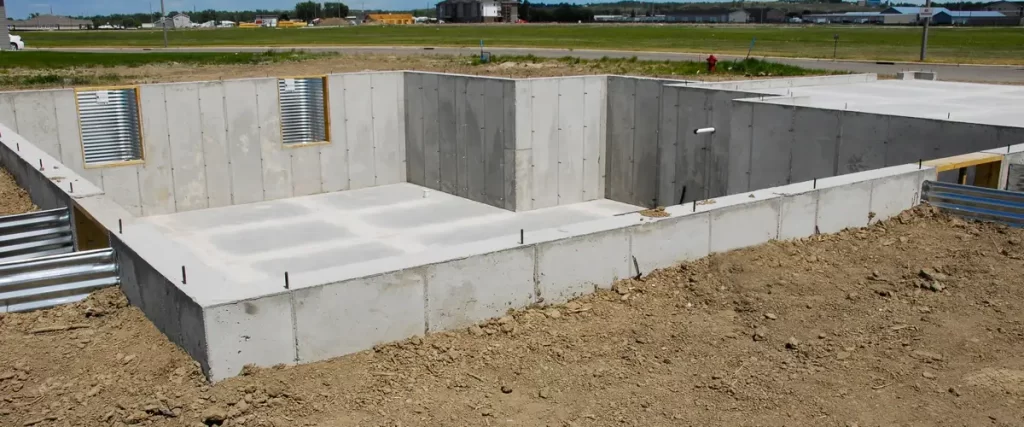
Full basement foundations require digging deeper, well below the frost line, which means more excavation and more concrete. But the payoff in square footage per dollar spent is hard to beat. They’re most common in colder climates, where builders already have to dig below the frost line.
Pros:
- Additional living and storage space
- Strong resale value
- Mechanical systems are easily accessible
Cons:
- Higher excavation and construction cost
- Moisture risk without proper drainage systems
- Not practical in warm climates or areas with high water tables
Basements are vulnerable to moisture. Proper drainage systems, waterproofing, and drainage pipes are non-negotiable if you want a dry basement that holds its value.
3. Crawl Space Foundation

A crawl space foundation raises the home off the ground on short foundation walls, leaving a narrow gap between the ground and the floor system.
This setup gives you easy access to plumbing, wiring, and HVAC components without tearing up a concrete floor.
Pros:
- Easy access to utilities for repairs
- Works well on uneven ground and sloped lots
- Less excavation than a full basement
Cons:
- Poor moisture management leads to mold, rot, and pest problems
- Requires encapsulation and drainage to perform well
- Adds complexity compared to a simple slab
Crawl space foundations work well on uneven ground and sloped lots where a slab wouldn’t be practical.
4. Pier and Beam Foundation
A pier-and-beam foundation uses concrete piles or wooden posts driven into the ground to support the structure above. The home sits elevated, with beams transferring the load to the piers below.
Pros:
- Elevated structure reduces flood damage risk significantly
- Works well in poor soil conditions and expansive clay
- Minimal excavation required
Cons:
- Wood components are vulnerable to rot and pests
- Open underside requires regular inspection and maintenance
- Less stable than concrete-based systems on certain soil types
This is a common choice in flood-prone areas, coastal regions, and properties with poor soil conditions.
5. Stone Foundation
Stone foundations are most common in older homes, some dating back a century or more. Builders stacked fieldstone or cut stone, sometimes with mortar, to create foundation walls that, in many cases, have lasted generations.
Pros:
- Exceptional longevity when properly maintained
- Excellent load-bearing capacity
- No manufactured materials required
Cons:
- Highly porous and prone to water infiltration
- Rarely meets modern building codes without significant remediation
- Difficult and costly to repair or modify
If you’re restoring a historic property, you’ll likely deal with a stone foundation.
6. Insulated Concrete Forms (ICF Foundation)
Insulated concrete forms use foam blocks as both the formwork and the permanent insulation. You stack the forms, pour concrete into them, and end up with concrete walls that are also heavily insulated.
The result is outstanding energy efficiency, translating into lower heating and cooling costs year after year.
Pros:
- Exceptional energy efficiency compared to standard concrete walls
- High soundproofing
- Strong, structurally sound wall structure
Cons:
- Higher upfront cost than poured concrete or concrete blocks
- Requires contractors familiar with ICF construction
- Overkill in mild climates where insulation isn’t a priority
It requires a higher upfront cost, but energy savings over time often justify it, especially in climates with extreme temperatures.
7. Wood Foundation
Pressure-treated wood foundations are less common, but they exist. They’re faster to install in certain conditions and can provide decent insulation. Some builders use them in remote areas where concrete delivery is logistically difficult.
Pros:
- Faster installation than concrete-based systems in remote areas
- Provides reasonable insulation
- Lower material cost in areas where concrete is hard to source
Cons:
- Long-term durability is lower than that of concrete
- Requires diligent waterproofing and drainage to avoid rot
- Less widely accepted by engineers and lenders
Modern pressure treatment has come a long way, but most builders and engineers still prefer concrete-based systems for long-term stability.
How to Choose the Right Foundation
Your choice comes down to a few key factors:
- Climate: Cold climates demand foundations that go below the frost line. Warm climates have more flexibility.
- Soil conditions: Expansive clay, sandy soil, or poor soil conditions change what’s structurally sound.
- Site topography: Sloped lots often favor pier-and-beam or crawl-space systems.
- Flood risk: Elevated foundations are the safer option in flood-prone areas.
- Budget and goals: A full basement adds living space, a slab cuts costs, while an ICF foundation saves energy long-term.
If you’re working with a custom home builder, they should conduct a soil analysis and review local building codes before recommending anything.
FAQ
What is the most common house foundation type in the US? The concrete slab is the most widely used foundation, particularly in southern states where warm climates and stable soils make it practical. Basements are more common in the Midwest and Northeast.
Which foundation type is best for cold climates? Full basement foundations and ICF foundations both perform well in colder climates. They’re designed to extend below the frost line and provide better insulation than slab options.
What foundation type is best for flood-prone areas? Pier-and-beam foundations are recommended by FEMA for homes in high-risk flood zones. Raising the home above ground level significantly reduces flood damage risk.
How long does a poured concrete foundation last? A well-built, poured concrete foundation can last 50 to 100 years or more with proper maintenance and drainage. Moisture is typically the biggest long-term threat.
Can I add a basement to a home with a slab foundation? It’s technically possible, but extremely expensive and disruptive. Most contractors advise against it unless absolutely necessary. It usually makes more financial sense to account for basement needs during the original build.
What causes foundation problems? Poor drainage, expansive soils, tree root intrusion, and improper construction are the most common culprits. Foundation repair can range from minor crack sealing to significant structural work, depending on the cause and severity.
Is a crawl space or slab better for resale value? It depends on the market. In areas where crawl space foundations are standard, buyers expect them. In warm climates where slabs dominate, a crawl space can be seen as a premium feature because it provides easier access for repairs.
The Simplest Solution
Understanding every house foundation type is useful, but applying that knowledge to your specific lot, budget, and goals? That’s where it gets complicated. Soil reports, drainage assessments, building code compliance, and contractor bids are no simple tasks.
Honestly, the most straightforward path is just talking to someone who’s done this hundreds of times. Call us at (562) 319-3178 or message us here, and let’s figure out what actually makes sense for your build.